
Blog
Multi-Vehicle Car Accidents in New Jersey: How Fault Is Determined
- April 05, 2026 Leer en Español
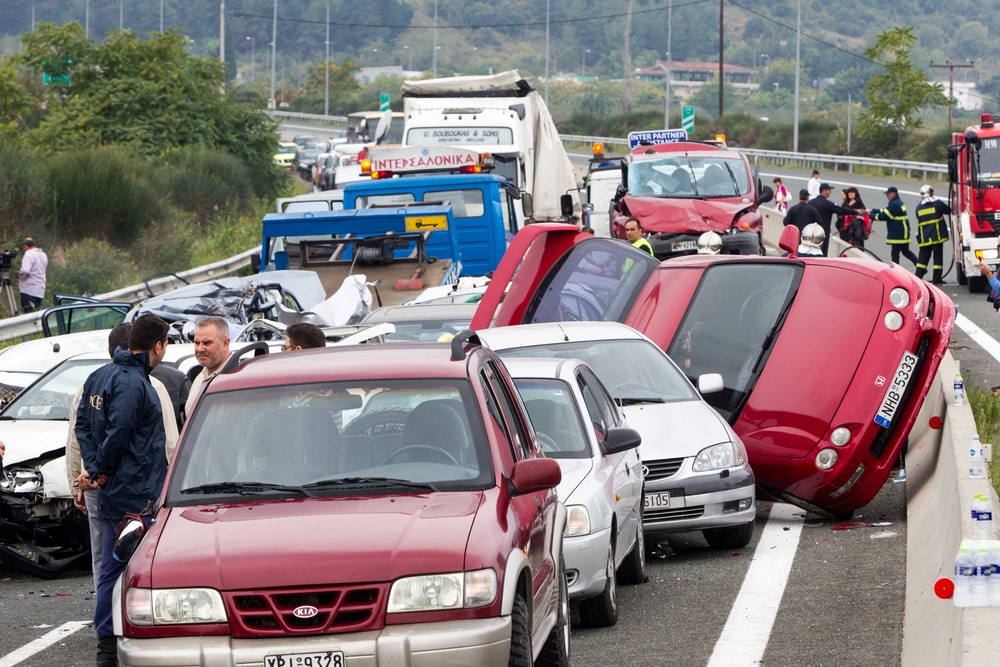
A single mistake on a New Jersey highway can set off a chain reaction — one rear-end collision becomes five, ten, or even twenty vehicles tangled across lanes. These multi-vehicle accidents (also called pileups) are some of the most dangerous and confusing crashes on the road.
In seconds, lives change — and so does the legal landscape. Who caused the initial collision? Which drivers contributed to the damage? How do insurance companies decide who pays what?
At Antonucci Law, we’ve seen how chaos at the crash scene quickly becomes chaos in the claims process. As experienced car accident attorneys in Union, NJ, our mission is to bring clarity, evidence, and justice to even the most complex cases.
Why Multi-Vehicle Accidents Are So Complicated
Unlike a two-car crash, a multi-vehicle accident in NJ involves several drivers, multiple insurance carriers, and sometimes conflicting police reports. Determining fault isn’t about pointing fingers — it’s about reconstructing the sequence of events with precision.
Each driver’s actions are evaluated individually. In many cases, more than one driver is partially responsible. And because of New Jersey’s comparative negligence law, that division of fault directly affects compensation.
These accidents often involve:
- Rear-end chain collisions during rush hour
- Pileups caused by fog, ice, or sudden stops
- Highway crashes involving commercial trucks
- Collisions on bridges or tunnels where escape routes are limited
- Secondary impacts caused by vehicles swerving to avoid the first crash
The result? Dozens of injury claims, overlapping stories, and insurers racing to minimize their exposure.
That’s why having a pileup car crash lawyer with trial experience is critical. Without a strong advocate, victims risk being blamed for accidents they didn’t cause.
How Fault Is Determined in Multi-Vehicle Accidents
1. Police Reports Are the Starting Point — Not the Final Word
Police officers document their observations at the scene, including skid marks, vehicle positions, and driver statements. However, these reports often contain inconsistencies or incomplete timelines.
While they’re important, they don’t always tell the whole story. At Antonucci Law, we treat the police report as one piece of the puzzle — then we dig deeper.
2. Accident Reconstruction Reveals the Full Picture
We work with professional accident reconstruction experts who analyze:
- Skid patterns, debris fields, and vehicle damage
- Data from vehicle black boxes (speed, braking, impact timing)
- Weather, lighting, and road conditions
- Surveillance footage or dashcam recordings
Using these details, they recreate how the collision unfolded — often disproving assumptions or false statements. In court, these reconstructions can make or break a case.
This step is especially vital when several drivers claim, “I couldn’t stop in time.” An expert can show who had the last clear chance to avoid impact — a key concept in comparative negligence.
3. Witness Testimony and Video Evidence Fill in the Gaps
With multiple cars involved, eyewitnesses may provide conflicting accounts. We locate every possible source of truth — traffic cams, business security systems, and even smartphone videos.
Our team also issues evidence preservation requests to ensure footage isn’t deleted, especially from commercial vehicles or rideshare drivers equipped with onboard cameras.
Understanding Comparative Negligence in New Jersey
New Jersey follows a modified comparative negligence rule under N.J.S.A. 2A:15-5.1. That means:
- You can still recover damages if you’re 50% or less at fault.
- Your compensation is reduced by your percentage of responsibility.
- If you’re more than 50% at fault, you can’t recover damages at all.
Here’s an example:
If you’re awarded $100,000 but found 20% at fault, your final recovery is $80,000.
This rule adds complexity to multi-car crashes, where fault may be divided among multiple drivers. A car accident attorney in Union, NJ can ensure your percentage of fault is fairly calculated — not exaggerated by insurance companies trying to minimize payouts.
The Role of Insurance Companies
In a multi-vehicle accident in NJ, several insurance carriers will investigate simultaneously. Each one tries to protect its own driver — which often means shifting blame to someone else.
Common tactics include:
- Claiming your injuries existed before the accident.
- Arguing you “could have avoided” the collision.
- Misinterpreting police reports or witness statements.
- Delaying communication to pressure you into a low settlement.
At Antonucci Law, we handle these interactions directly, preventing insurers from twisting words or devaluing your claim. We manage the paperwork, correspondence, and negotiations — so you don’t get caught in a blame game you didn’t start.
Common Injuries in Multi-Vehicle Collisions
The force of multiple impacts often leads to severe or catastrophic injuries, including:
- Traumatic brain injuries
- Spinal cord injuries and paralysis
- Whiplash and soft tissue damage
- Internal bleeding or organ trauma
- Broken bones and crush injuries
- Emotional trauma and anxiety
These injuries can require months or years of recovery — and in some cases, lifelong care. That’s why proper evidence, early legal action, and aggressive representation matter so much.
Why Expert Analysis Is Essential
When several vehicles collide, even minor details — such as brake lights, following distance, or impact timing — can determine liability.
Our experts reconstruct these details frame by frame. Using physics modeling, impact simulation, and computer graphics, they provide visuals that clarify the sequence of collisions for judges and juries.
This scientific evidence gives your case credibility — especially when insurers insist “no one can know” who caused the pileup.
The Difference Between Rear-End Chains and Pileups
Not all multi-car accidents are the same.
- Rear-End Chains: These typically occur on highways or at intersections. Driver 1 stops suddenly, Driver 2 reacts too late, and the chain reaction continues.
- Pileups: These usually involve 5 or more vehicles, often triggered by visibility issues or high-speed impacts. Pileups can block entire roadways and lead to secondary collisions with emergency responders.
Both scenarios require specialized investigation, but pileups are particularly complex because of overlapping claims and high damages.
How a Pileup Car Crash Lawyer Builds Your Case
At Antonucci Law, our step-by-step approach ensures no angle is missed:
- Scene Investigation: We examine skid marks, impact points, and debris to establish the first point of contact.
- Accident Reconstruction: We work with engineers and forensic experts to model the crash dynamics.
- Driver Statements: We compare each driver’s version with objective data to identify inconsistencies.
- Insurance Review: We evaluate all available coverage — including commercial or rideshare policies if applicable.
- Medical Documentation: We track your injuries, treatment, and long-term prognosis to establish full damages.
- Litigation Preparation: Every case is prepared as if it will go to trial — because that’s what makes insurers take it seriously.
This comprehensive method transforms complex claims into clear, evidence-driven narratives that demand fair settlements.
Why You Need a Car Accident Attorney in Union, NJ
Navigating New Jersey’s legal system after a multi-car crash can be overwhelming — especially when multiple insurance companies are pressuring you to settle.
Working with a car accident attorney in Union, NJ ensures:
- Evidence is preserved before it disappears.
- Fault percentages are challenged when exaggerated.
- Medical and economic damages are fully calculated.
- You have courtroom leverage through certified trial experience.
At Antonucci Law, we’ve built our reputation on being both compassionate advocates and relentless litigators. We don’t just handle your claim — we rebuild your confidence after trauma.
Real Questions from Real Clients
“What if the first driver caused the chain reaction, but I only hit someone because I was rear-ended?”
You may still recover damages. If you were pushed into another car because of someone else’s impact, liability likely rests with the initial negligent driver — not you. We’ll analyze impact points and reconstruction reports to prove your innocence.
“Do I have to sue every driver involved?”
Not necessarily. Most claims are handled through insurance negotiations. However, if any insurer refuses to pay fairly, we can pursue specific defendants while keeping your recovery on track.
“What if weather played a role — like fog or black ice?”
Hazardous weather doesn’t excuse negligence. Drivers must adjust speed and behavior to conditions. Failing to do so can still make them liable.
“Will my insurance rates go up even if I wasn’t at fault?”
If you’re found not at fault, your premiums typically shouldn’t rise. However, insurers sometimes misclassify claims. We help correct inaccuracies to protect your record.
“How long do I have to file a claim?”
In New Jersey, the statute of limitations for personal injury claims is two years from the date of the crash. But in complex multi-car accidents, evidence disappears fast — so it’s best to act immediately.
Fault Takes Evidence, Not Guesswork
When multiple vehicles collide, everyone points fingers — but only facts decide liability.
At Antonucci Law, we combine expert reconstruction, local experience, and trial-tested advocacy to uncover the truth and protect your rights.
Whether you were the first car hit or caught in the middle, our attorneys will guide you step by step through the investigation, negotiation, and (if needed) litigation process.
If you’ve been injured in a multi-vehicle accident in NJ, call Antonucci Law today for a free consultation.
No upfront fees. No confusion. Just results built on preparation and integrity.
No upfront fees. No confusion. Just results built on preparation and integrity.
Put us to work for you with a